Alternative Art and Anthropology by Arnd Schneider
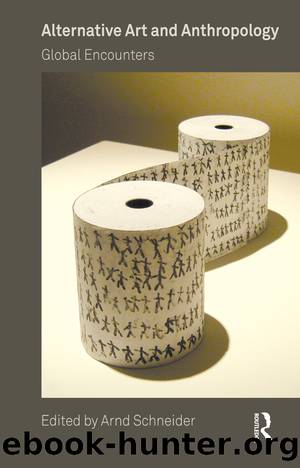
Author:Arnd Schneider [Schneider, Arnd]
Language: eng
Format: epub
ISBN: 9781474231251
Barnesnoble:
Goodreads: 29565876
Publisher: Taylor & Francis
Published: 2017-02-23T00:00:00+00:00
Speaking of which, some might think that I would agree with the full commercialization of 798, but in fact, like the vast majorityâs point of view, I wish it to be more artisticâafter all, art is the soul of this place. However, we can see that most of the time, reality is not pre-designed, it has its own path and law of development. Its next step will also be self-planned based on its own needs. I do not prefer excessive government planning on it, and also am not in favor of many scholarsâ ideas. I would rather believe in the self-regulation of the society and market, as well as the creativity of the people living there. I assume that people will figure out a new way of life which best fits this new era, and the artists will find their right position in the cityâs development process. During the industrial ages, artists were marginal to the life of the city. However in the future, when the city becomes a fresh landscape and brand new symbolic space, artists could be its most important workers. In the post-industrial era, as we transfer from a capitalist society to a knowledge-based one, I believe that we will need more scientists and engineers; in the meantime, more artists and designers are also neededâbecause human beings are always in need of a poetic living, and as a cultural space full of imagination an art district is just as qualified.
Life was remote from art in the industrial ages; people only made practical products that had use value but with very little cultural connotation or symbolism. People focused more on man / machine functions and the relationship between cost and working hours; the products were all cold industrial goods with no emotional meaning. While in the agricultural ages, even a bowl, a spoon, or a table has its elaborate decorations and exquisite handicraftsâalmost all the necessities of that era are works of art to us today. Thatâs because they were made with a soul and were endowed with cultural significance. In todayâs postmodern culture the question is whether we can return to the original meaning of the world, and let our living spaces and cities be filled with art. Such spaces would not only contain our history and our culture, but also a great many new artistic creations. In the future, the artists will become the major builders of the urban landscape and environment, and the art district will not be shrinking, but constantly expanding.
Download
This site does not store any files on its server. We only index and link to content provided by other sites. Please contact the content providers to delete copyright contents if any and email us, we'll remove relevant links or contents immediately.
The Great Music City by Andrea Baker(33841)
Aircraft Design of WWII: A Sketchbook by Lockheed Aircraft Corporation(32388)
Call Me by Your Name by André Aciman(20744)
The Secret History by Donna Tartt(19487)
The Art of Boudoir Photography: How to Create Stunning Photographs of Women by Christa Meola(18779)
Shoot Sexy by Ryan Armbrust(17862)
Plagued by Fire by Paul Hendrickson(17549)
Portrait Mastery in Black & White: Learn the Signature Style of a Legendary Photographer by Tim Kelly(17111)
Adobe Camera Raw For Digital Photographers Only by Rob Sheppard(17100)
Photographically Speaking: A Deeper Look at Creating Stronger Images (Eva Spring's Library) by David duChemin(16805)
Ready Player One by Cline Ernest(15159)
Pimp by Iceberg Slim(14808)
Bombshells: Glamour Girls of a Lifetime by Sullivan Steve(14234)
The Goal (Off-Campus #4) by Elle Kennedy(13985)
Art Nude Photography Explained: How to Photograph and Understand Great Art Nude Images by Simon Walden(13156)
Kathy Andrews Collection by Kathy Andrews(12110)
The Priory of the Orange Tree by Samantha Shannon(9378)
The remains of the day by Kazuo Ishiguro(9236)
Thirteen Reasons Why by Jay Asher(9138)
